
The Supreme Court has stated it will not make structural changes to religious practices at the Bankey Bihari temple in Vrindavan, hearing a petition challenging administrative decisions affecting traditions.

A nine-judge Supreme Court bench has reserved its order on petitions related to discrimination against women at religious places, including the Sabarimala temple, and the scope of religious freedom.

The Supreme Court of India has asserted its jurisdiction to determine what constitutes a superstitious practice within a religion, during a hearing on petitions related to discrimination against women at religious sites.

The Supreme Court of India has stated that religious institutions must have structure and norms for their functioning, emphasising that the right to manage a religious institution does not imply an absence of order.
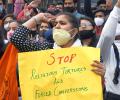
A tribal family in Chhattisgarh's Narayanpur district was briefly evicted from their village by residents over alleged religious conversion but was allowed to return after agreeing to reconvert to their original faith. Police and district officials intervened to resolve the dispute.
The Supreme Court of India has dismissed the use of information from 'WhatsApp University' as evidence in a case concerning religious freedom and discrimination against women at religious sites, including the Sabarimala Temple.

A female employee of TCS in Nashik has been arrested in connection with alleged religious conversion and sexual harassment of female colleagues. Nida Khan was apprehended in Chhatrapati Sambhajinagar after weeks of being in hiding. The case involves allegations of forced religious practices and harassment within the TCS unit.
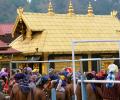
The Travancore Devaswom Board (TDB), managing the Sabarimala temple, argued in the Supreme Court that religious beliefs should be judged subjectively by the community, as the court hears petitions related to discrimination against women at religious places.
A female employee of TCS in Nashik has been arrested in connection with a case involving alleged religious conversion and sexual harassment of female colleagues. Nida Khan was apprehended after weeks of being in hiding. The Nashik police are investigating multiple cases of molestation and harassment at the TCS unit.
The Supreme Court has stated that roads cannot be blocked for religious activities and that while religious denominations have autonomy in worship, the government can interfere if secular activities are affected.

The Centre has informed the Supreme Court that the restriction on women of menstruating age entering Kerala's Sabarimala temple is a matter of religious faith and denominational autonomy, falling outside the purview of judicial review. Solicitor General Tushar Mehta argued that courts should not apply 'secular standards of reason' to religious practices.
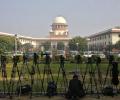
A nine-judge Supreme Court bench has commenced hearing on petitions related to discrimination against women at religious places, including the Sabarimala temple, and the scope of religious freedom across faiths.
The Supreme Court of India has voiced concerns about the potential consequences of individuals questioning religious practices in constitutional courts, warning it could lead to the fragmentation of religions and civilisation. A nine-judge Constitution bench is hearing petitions related to discrimination against women at religious places and the scope of religious freedom.
A Nashik court has rejected the bail pleas of five individuals arrested in connection with the TCS sexual harassment and forced conversion case. The Special Investigation Team is probing multiple cases of molestation and harassment at the IT major's Nashik unit.

The Supreme Court questioned the chief priest of the Sabarimala Ayyappa Temple regarding the constitutionality of preventing believers from touching the deity, during hearings on discrimination against women at religious sites.
The Supreme Court of India has ruled that the secular nature of the state does not prevent it from interfering with religious practices and attitudes when they impede development and the right to equality in the larger public interest. The court dismissed pleas challenging the 1976 amendment to the Constitution, which added the terms "socialist", "secular", and "integrity" to the Preamble, stating that Parliament's amending power extends to the Preamble as well.

The Centre has supported the restriction on women of menstruating age entering Kerala's Sabarimala temple, arguing that the Supreme Court's 2018 judgement assumes male superiority.
The Supreme Court of India has observed that the practice of excommunicating Parsi women for entering into interfaith marriages is prima facie discriminatory, emphasising that the right of conscience is a birthright.

The Supreme Court observed that Hinduism is a way of life, stating that mandatory temple visits or rituals are not necessary to be considered a Hindu; even lighting a lamp at home suffices.
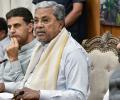
Karnataka Chief Minister Siddaramaiah has clarified that saffron shawls are not permitted in educational institutions, while existing practices such as hijab, turbans, rudraksha beads, and sacred threads will continue to be allowed.

The chapter, State and Society up to 1000 CE, says the Vedic period is 'often described as a period during which women held a high and respectful position in society'.
The Special Investigation Team (SIT) probing the TCS sexual harassment-forced conversion case filed its second chargesheet in a Nashik court on Thursday. The chargesheet pertains to eight FIRs registered at Mumbai Naka police station here under Bharatiya Nyaya Sanhita provisions against several individuals.
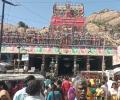
The Tamil Nadu government has approached the Supreme Court to challenge a Madras High Court order that permitted the lighting of a ceremonial lamp on the Thirupparankundram hill. The state government cited concerns over public order and potential communal tensions, while the High Court had dismissed these fears as "imaginary" and affirmed the land belongs to the Sri Subramania Swamy Temple, not the Waqf Board.
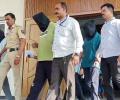
Nida Khan, an accused in the Nashik TCS sexual harassment and religious coercion case, has been arrested in Chhatrapati Sambhajinagar. She is accused of targeting employees in a WhatsApp group, pressuring them to pray and eat non-vegetarian food, and advising women employees to adhere to Islamic traditions.

The Supreme Court on Friday allowed women of all ages in the Ayyappa temple at Sabarimala in Kerala. While Justices R F Nariman and D Y Chandrachud concurred with Chief Justice of India Dipak Misra and Justice A M Khanwilkar on the ruling that banning the entry of women in the temple is gender discrimination and the practice violates the rights of Hindu women, Justice Indu Malhotra gave a dissenting verdict. Here are highlights of her judgment.

BJP leader Kirit Somaiya has written to Mumbai authorities, urging them to stop the offering of namaz on public roads, claiming it causes traffic disruption and inconvenience. Trinamool Congress leader Majeed Memon agreed that namaz on roads should not be allowed due to inconvenience but attributed it to a lack of mosque space.
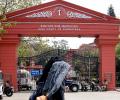
The Karnataka high court, which dismissed the batch of petitions by some Muslim girl students from Udupi seeking permission to wear the hijab inside classrooms, said there was no material placed on record to prima facie show that wearing the headscarf was an essential religious practice.
Self-proclaimed godman Ashok Kharat, accused of portraying himself as Lord Shiva and using black magic to extort money from victims, has been arrested by the Enforcement Directorate.

US Vice President JD Vance on Sunday generated significant online traction after making a light-hearted reference to two "very, very important" Indian and Pakistani people in his life - his wife Usha Vance and Pakistani Army chief Asim Munir, on the sidelines of the US-Iran diplomatic deliberations in Switzerland.

Large crowds gathered in Southampton on Tuesday evening as officers from Hampshire and Isle of Wight Constabulary stood in riot gear near the home of Vickrum Digwa, who was sentenced to life imprisonment for stabbing 18-year-old Henry Nowak to death.
The Shabari story in the Ramayana found mention before a nine-judge constitution bench of the Supreme Court on Wednesday while hearing petitions related to discrimination against women at religious places, including the Sabarimala temple in Kerala.

The Indian government has amended the Foreign Contribution Regulation Act (FCRA) rules, introducing stricter regulations for NGOs receiving foreign funds. Key changes include mandatory selection of predefined purposes and areas of operation, restrictions on foreign nationals as key functionaries, and explicit exclusion of proselytisation from certain faith-based activities. The amendments also introduce minimum spending limits, enhanced financial accountability, and increased transparency requirements, including social media disclosure and ultimate donor identification.

Newly appointed West Bengal minister Bishal Lama performed a puja before occupying his new office, which was previously used by former education minister Partha Chatterjee, who was arrested in a school jobs scam. Lama stated it was a personal tradition for auspicious beginnings.

The videos were shown so that the woman could learn about Islam, she said in her statement, which is part of the chargesheet submitted in a Nashik court last week.

An AIMIM corporator allegedly harboured Nida Khan, an accused in the alleged sexual harassment and religious coercion case at TCS, and her family in Chhatrapati Sambhajinagar, the police said on Friday.

Recent controversies at major IT firms like TCS and Infosys have highlighted a persistent gap between workplace conduct policies and their implementation in corporate India. While companies assert zero tolerance for harassment and discrimination, employees and experts point to uneven enforcement and the need to embed ethical behaviour into organisational culture.
Recent controversies at major IT firms like TCS and Infosys have highlighted a persistent gap between workplace conduct policies and their implementation in corporate India. While companies assert zero tolerance for harassment and discrimination, employees and experts point to uneven enforcement and the need to embed ethical behaviour into organisational culture.
A couple in Uttar Pradesh were allegedly humiliated and forced to wear garlands made of shoes following a family dispute over land and rumours of religious conversion. Police have denied the conversion allegations, stating the issue is related to a land dispute.
The Supreme Court of India questioned the Centre regarding the eligibility of non-devotees to challenge the customs of the Sabarimala temple in Kerala, during a hearing on religious freedom and discrimination against women at religious sites.

Varanasi Municipal Corporation's decision to relocate all meat, fish, and poultry shops outside city limits before the holy month of Sawan has ignited a debate among residents, traders, and political leaders, with supporters citing religious sentiments and critics raising concerns about convenience and livelihoods.
